How to Match a Solid Wood Headboard and Matching Furniture to a Warm Minimal Interior (Without Losing Your HDB's Airy Feel)
I spent last month at a friend's new 4-room HDB in Punggol, helping her style a 110 sqm layout around a single decision: the headboard. She had pulled up three Pinterest boards of warm minimal interiors, but everything looked either too cold or too cluttered once we stood inside her actual bedroom. The lift at her block is 1.6 m wide, the corridor outside her unit is 1.2 m, and her bedroom door is 0.9 m. Those three numbers quietly dictated almost every choice we made that afternoon, and they're the same numbers anyone furnishing a Tampines or Bedok resale flat will run into.
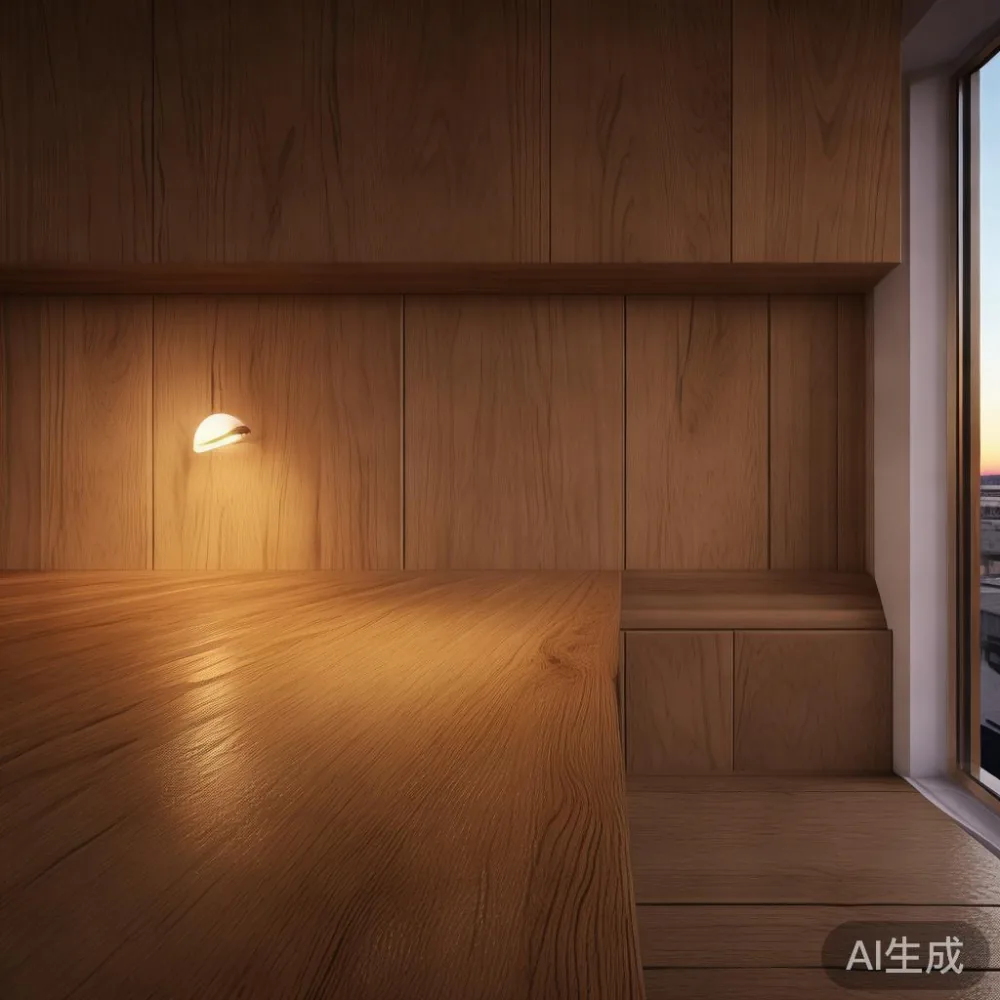
The warm minimal look lives or dies by restraint. You want cream walls, oak or walnut tones, one curved silhouette, no visible clutter. Most Singapore homeowners who chase the look fail at the very first piece they buy, because the piece is too large, too dark, or too detailed. A solid wood headboard, when chosen with the right proportions, anchors the room and quietly pulls every other piece of furniture into a calmer palette. Everything in this article is written for the realities of local living: tight lifts, narrow corridors, GST 9% on top of every invoice, and a tropical humidity that punishes cheap laminates within eighteen months.
Why the Headboard Sets the Direction for the Whole Warm Minimal Bedroom
In a warm minimal interior, the headboard is the largest single vertical plane the eye lands on after the door. If it is loud, everything else becomes filler. If it is quiet, everything else can breathe. That is why designers in Tanjong Pagar showrooms and the Hipvan stores in Tai Seng consistently push a wooden headboard in oak veneer or solid ash over an upholstered one for the warm minimal look: wood absorbs light, scatters it gently, and never goes out of fashion in three years.
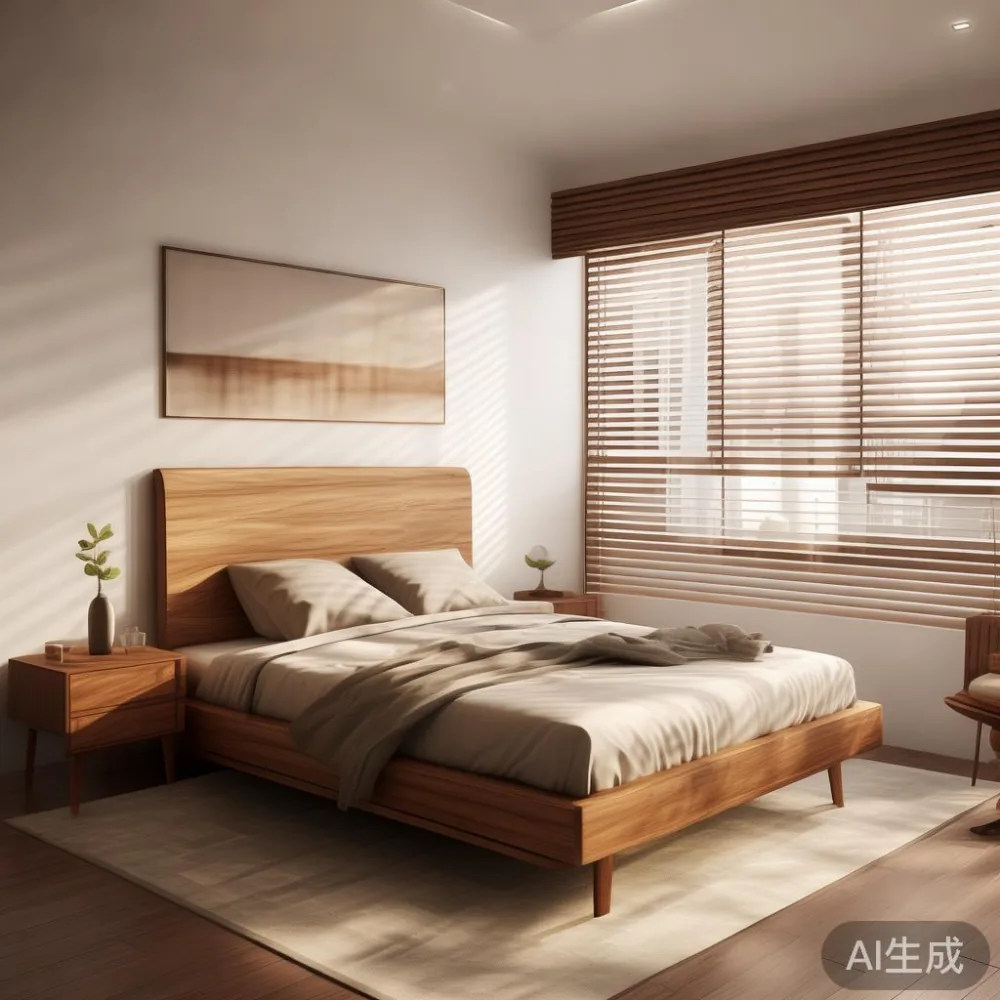
The geometry also matters. A headboard between 95 cm and 115 cm tall usually reads as calm against a 2.7 m HDB ceiling. Anything above 130 cm starts to crowd the wall, and you lose the airy negative space that defines the style. For a king-size mattress (180 x 200 cm), choose a headboard around 200-220 cm wide and 100-110 cm tall. For a queen (150 x 200 cm), stay within 170-190 cm wide. The thickness should be a maximum of 8-9 cm; thicker panels start to look post-modern light luxury rather than warm minimal.
Materials matter just as much as dimensions. Solid ash, solid oak, and solid walnut all behave differently under Singapore's 80-90% humidity. Ash is the most forgiving at roughly S$1,400-S$2,200 for a queen-sized headboard in a reputable local workshop. Oak pushes the price to S$2,400-S$3,600, and walnut climbs further. Cheaper MDF with paper veneer starts at S$450-S$700, but you can usually see the corner joint lifting by month eight. A proper solid wood headboard from a maker with kiln-dried timber and a ten-year structural warranty is the cheapest decision per year of use, even if the receipt hurts on day one.
How to Match the Bed Frame, Nightstand, and Wardrobe to the Headboard Tone
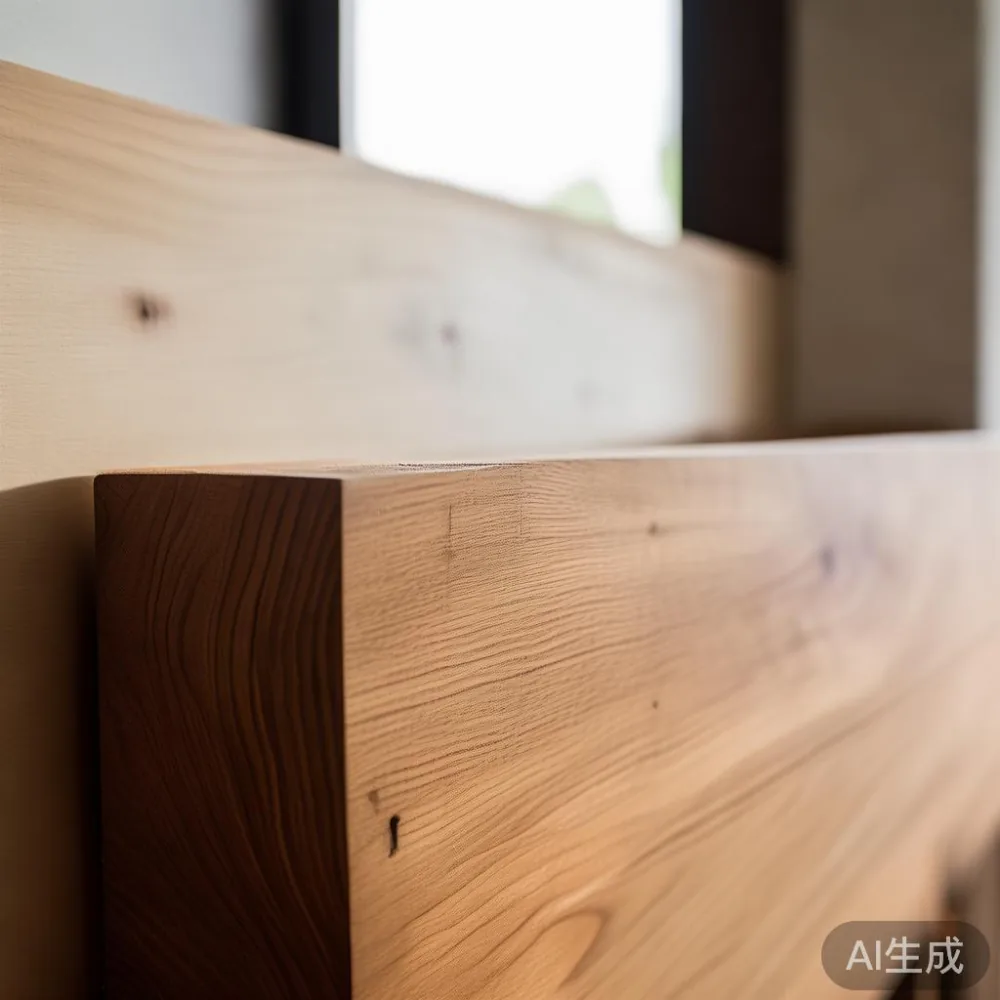
Once the headboard is set, every other piece should answer to it. The simplest rule is to keep all wood within one tone group: light, medium, or dark. If your headboard is a warm honey oak, your bed frame, nightstand, and wardrobe should sit inside the same honey family, ideally within half a shade on the warm-cool spectrum. Jumping from honey oak to grey ash in the same room breaks the warmth even if the colours look fine on a screen.
For a queen bedroom in a 4-room HDB, I recommend a three-piece suite rather than a full bedroom set. The three pieces that carry the most visual weight are the bed frame (because it is wide), the wardrobe (because it is tall), and the nightstand (because it sits at eye level when you sit up reading). The dresser, bench, and mirror can come later as the room settles.
Bed frame: choose a low-profile platform frame in the same wood as the headboard, with legs no taller than 20 cm. A solid wood platform frame in queen size weighs 38-45 kg for ash and 50-58 kg for walnut. That weight is actually useful in a HDB because a heavy frame does not slide when you throw pillows across it. Budget around S$1,800-S$3,200 for a solid ash platform frame, S$3,000-S$4,800 for oak, and S$4,500-S$6,500 for walnut. Make sure the slats are at least 14 pieces across the queen width; anything below 10 will bow under a 25-30 kg mattress and start squeaking by month ten.
Nightstand: pick a two-drawer unit, 45-55 cm wide, 50-60 cm tall. The top should finish level with your mattress or 2-3 cm below; nightstands that tower over the mattress break the horizontal calm the warm minimal look relies on. Solid ash nightstands run S$550-S$900 each, walnut S$1,100-S$1,600. Skip the glass or marble top for the warm minimal aesthetic; cool materials fight the wood's warmth.
Wardrobe: this is the piece most HDB owners underestimate. A full-height wardrobe in a standard 4-room bedroom recess is usually 180 cm wide x 220 cm tall x 60 cm deep. For warm minimal, choose flat-panel doors in the same wood as the headboard, no visible handles (push-to-open or recessed finger pulls), and at most one internal drawer bank. A 1.8 m solid ash wardrobe runs S$3,200-S$4,800 at most local custom workshops. A 2.4 m version, which fits a Bedok five-roomer's master bedroom more comfortably, runs S$4,200-S$6,400. Watch out for any quote under S$2,800 for a 1.8 m unit; that almost always means MDF carcass with a paper foil skin, which will swell at the edges inside six humid months.
What is the difference between French neoclassical wardrobe and modern furniture?
A French neoclassical wardrobe uses straight fluted columns, tapered legs, low-relief carved panels, and a base moulding that visually lifts the piece off the floor, while a modern wardrobe is a flat-panel box with no ornament, no legs, and a 2-5 cm recessed toe kick. The neoclassical style is a quieter, more disciplined cousin of Louis XV and Louis XVI, leaning on proportion and symmetry rather than heavy carving, which is why it photographs beautifully next to a warm minimal bedroom without overpowering it. A 100% solid wood French neoclassical wardrobe from a Foshan workshop typically costs S$5,200-S$8,400 for a 2.4 m four-door unit, delivered to Singapore, including the lift-up floor-to-ceiling model. A modern flat-panel wardrobe in the same size and material sits closer to S$3,800-S$5,600. The neoclassical price premium of roughly 35-50% pays for hand-rubbed finishes, dovetail joinery, and the longer sanding time the carved mouldings demand.
Choosing a Solid Wood Sofa, Dining Table, and Marble Table That Speak the Same Language
The bedroom is only half the warm minimal apartment. The living and dining zones need the same vocabulary or the eye will read them as two different flats stitched together by a corridor. For the living room, a solid wood sofa in ash or light walnut with cream or oat-coloured linen cushions is the cleanest match for a warm oak headboard. Avoid sofas with chrome legs; matte black or brushed brass feet are warmer and stay in the same tonal family as wood.
Sizing: a 2.4 m three-seater solid wood sofa in ash typically weighs 62-78 kg and costs S$3,800-S$6,200. A 2.8 m version climbs to S$5,000-S$7,800. Check that the sofa can be broken into pieces no wider than 0.85 m at the lift door. Most HDB lifts are 1.0-1.1 m wide internally, but the door is often only 0.8 m, and a single-piece sofa longer than 1.6 m will not turn the corner in the corridor. I measured this myself last month at a Tampines block where a customer had to refuse a 2.6 m one-piece sofa because the corridor was 1.1 m and the sofa refused to pivot at the 90-degree turn to her unit. Her fallback, a 2.4 m three-seater that splits into a 1.4 m seat and a 1.0 m chaise, went in without touching the walls.
Dining table: for a four-person HDB household, a 140 cm x 80 cm solid ash or oak dining table is the sweet spot. Six-person families in five-room flats should look at 160-180 cm x 85-90 cm. Solid ash four-seaters run S$1,600-S$2,800, oak S$2,600-S$4,200, walnut S$3,800-S$5,800. Keep the apron under 8 cm so chairs can tuck fully in; an apron over 12 cm eats 8-10 cm of usable knee space on every chair. If you want the same look but a different silhouette, a round 110-130 cm dining table softens a rectangular living-dining layout and lets the eye travel more gently, which suits warm minimal.
Marble table: this is where to bring in contrast without breaking the warm minimal feel. A small marble side table next to the sofa, or a 110 cm round marble coffee table, lifts the room from "all wood" to "wood and stone". Choose a honed (not polished) cream, travertine, or warm-grey marble. Polished Carrara reflects the ceiling and reads as cold. A 110 cm round marble coffee table on a solid ash or walnut base typically retails at S$1,800-S$3,400 locally. Treat it carefully: marble sealer should be reapplied every 12-18 months in Singapore humidity, otherwise coffee rings darken within thirty seconds and start etching by week two.
What About a Sofa Bed for Guests, Without Losing the Warm Minimal Look?
Many HDB owners need a guest bed for visiting parents from Malaysia or friends staying over weekends. A practical compromise is an American sofa bed usa-style sleeper sofa, which folds out into a 140 cm x 190 cm mattress without needing a spare bedroom. In Singapore, a solid ash frame sleeper sofa with a 10 cm high-density foam and 2 cm latex topper runs S$3,200-S$5,400 for a 2.0 m three-seater, and most reputable brands ship it within 14-21 days. The trick is to choose a sofa bed whose mattress thickness is at least 12 cm; anything thinner will fold your guests into a crease by 2 a.m.
Make sure the sofa bed mechanism is metal, not plastic. A steel scissor mechanism lasts 8-12 years of weekly use; a plastic equivalent usually fails by year three, with the click-clack getting louder each time until it refuses to close. Lift access matters again: a sleeper sofa in two boxes, each under 28 kg and no dimension over 1.2 m, will fit any standard HDB lift. Some sellers on Carousell ship a single 70 kg box; refuse that one unless you have a ground-floor unit.
Budget, Delivery, and Warranty: How to Plan the Whole Suite in SGD
Pulling the warm minimal look together across a full HDB usually means four to six solid wood pieces plus one marble accent. Here is a realistic budget in Singapore dollars, including GST, delivery, and basic installation:
Headboard, queen solid ash: S$1,800. Bed frame, queen solid ash platform: S$2,400. Two nightstands, solid ash: S$1,400. Wardrobe, 1.8 m solid ash flat-panel: S$3,800. Dining table, 140 cm solid ash: S$2,200. Three-seater solid wood sofa: S$4,800. Marble coffee table, 110 cm round: S$2,400. Total, before GST: S$18,800. After 9% GST: S$20,492. Delivery within Singapore mainland (free over S$350 purchase value from most Foshan-direct sellers such as MIDHILL, which I have personally watched deliver to a Jurong East unit in 28 days from the Foshan workshop): add S$120-S$280 depending on weight and lift access. Installation, where it is not included: S$240-S$480 for a full suite.
Warranty: a ten-year structural warranty on solid wood frames is now standard among mid-range Foshan exporters. Lifetime refinishing, which includes re-sanding, re-staining, and re-sealing once every 8-10 years, is offered by a handful of makers including MIDHILL, and it is genuinely useful in a tropical climate because humidity slowly greys wood within five to seven years. A single refinishing pass in Singapore costs S$280-S$520 per piece from third-party workshops, so lifetime coverage quietly saves you S$1,500-S$2,500 over the life of the suite.
Returns: most reputable sellers offer a 14-day return window for pieces that arrive damaged or fail basic structural inspection. Measure the lift door, the corridor width, and the bedroom door before the truck rolls out. A piece that fits on paper but not through the lift is a non-returnable loss of S$1,200-S$3,000 in most cases, because the seller has already paid sea freight from China.
Common Mistakes Singapore Buyers Make With Warm Minimal Furniture
The biggest mistake I see is mixing three wood tones in one room. A homeowner picks an oak wardrobe because it was on sale, a walnut bed frame because it looked darker on screen, and a teak dining table because the parent wanted something heavier. The room ends up looking like a furniture showroom rather than a calm home. Limit yourself to one tone family across the entire apartment, with at most one supporting tone at a 30% volume.
The second mistake is buying matte black metal accents everywhere. Black is fine on lamp bases, picture frames, and tap handles, but black-on-wood dining chairs, black-on-wood sofa legs, and a black TV console fight the warm minimal palette. Warm bronze, brushed brass, or unpainted timber legs keep the temperature consistent. Third, do not buy a wardrobe taller than 230 cm; it will press against the HDB ceiling cornice and visually shrink the room by an estimated 15-20%.
The fourth mistake, and the one I learned the hard way in my own place, is buying a marble dining table for daily family use. Marble is gorgeous for a coffee table or console, but a dining marble top shows every soy sauce splash and curry drip within seconds. For families who cook daily, a sintered stone top in a 12 mm thickness gives the same warm minimal look at roughly 60% of the price, with zero sealing and full stain resistance.
The fifth mistake is ignoring the lift and corridor. Always measure the lift door width (commonly 0.8-0.9 m), the lift internal depth (commonly 1.2-1.4 m), the corridor width (1.0-1.3 m in most HDB blocks), and the door to your unit (0.85-0.95 m). Any piece with a single-box dimension over 1.2 m in any direction is a risk unless the seller has confirmed it can be flat-packed into two boxes under 28 kg each.
FAQ: Warm Minimal Furniture in a Singapore HDB
Can I do warm minimal on a 3-room HDB budget of S$10,000?
Yes, but expect to start with the headboard, bed frame, and one nightstand, then add the wardrobe, sofa, and dining table over six to twelve months. Solid ash at the lower end of the price bands listed above will land you a credible suite for around S$9,500-S$10,800, including GST and delivery.
How long does sea freight from Foshan actually take?
From workshop to Singapore door, expect 18-32 days for in-stock pieces. Custom orders take 35-55 days. Foshan direct sellers such as MIDHILL have shipped to over fifteen countries since 2008, and the lead time for a Singapore HDB has stabilised around 24-30 days in the past two years. Add 2-3 days for GST clearance at Jurong Port.
Does solid wood really last longer than veneer in Singapore humidity?
Yes. A solid ash headboard at 9-11% moisture content will outlast a paper-veneered MDF headboard by roughly 8-12 years in a non-air-conditioned bedroom. In a daily air-conditioned bedroom (24-26 degrees, 50-60% RH), solid wood easily passes thirty years with one mid-life refinishing pass.
Should I match the headboard wood to the floor or to the wardrobe?
Match to the wardrobe first, then to the floor. The wardrobe and headboard share a wall in most HDB bedrooms, so the eye reads them as one surface. The floor is only seen when you are standing, which is roughly 5% of your waking time in that room. If the floor is a contrasting tone, choose a headboard that splits the difference, halfway between wardrobe and floor.
Is post-modern light luxury the same as warm minimal?
No. Post-modern light luxury includes curved silhouettes, brass details, and bolder stone or marble accents, while warm minimal relies on flat planes, oak or walnut, and one curved accent at most. A warm minimal apartment can borrow one or two post-modern light luxury pieces (a curved armchair, a travertine side table) without losing its identity, but a full post-modern light luxury suite will read as too dressy for the calm, restrained look most HDB owners want at the end of a long day.